AceStar Nexus
A local-first desktop companion designed to keep important tasks, goals, and personal metrics visible throughout the day.
AceStar Nexus grew out of my earlier Nexus project.
Nexus focused on developer analytics, but I found that having a dashboard was not enough — I still had to remember to open it. I wanted something that stayed visible on the desktop and surfaced what actually needed attention.
The result is a small always-on-top widget that expands into a full dashboard when needed.
The idea
The application runs locally, with the Python backend running as a sidecar process inside the Tauri desktop application.
External data sources are exposed through independent MCP servers rather than being tightly coupled to the backend.
The widget
The main interface is intentionally minimal.
Instead of showing another dashboard full of information, the widget focuses on the single most relevant item right now — such as an upcoming reminder, an overdue follow-up, or a goal falling behind.
It also provides a quick snapshot of:
- LeetCode progress
- GitHub activity
- Fitness status
- Reminders and todos
The widget stays visible while the full dashboard remains available when more detail is needed.
What it tracks
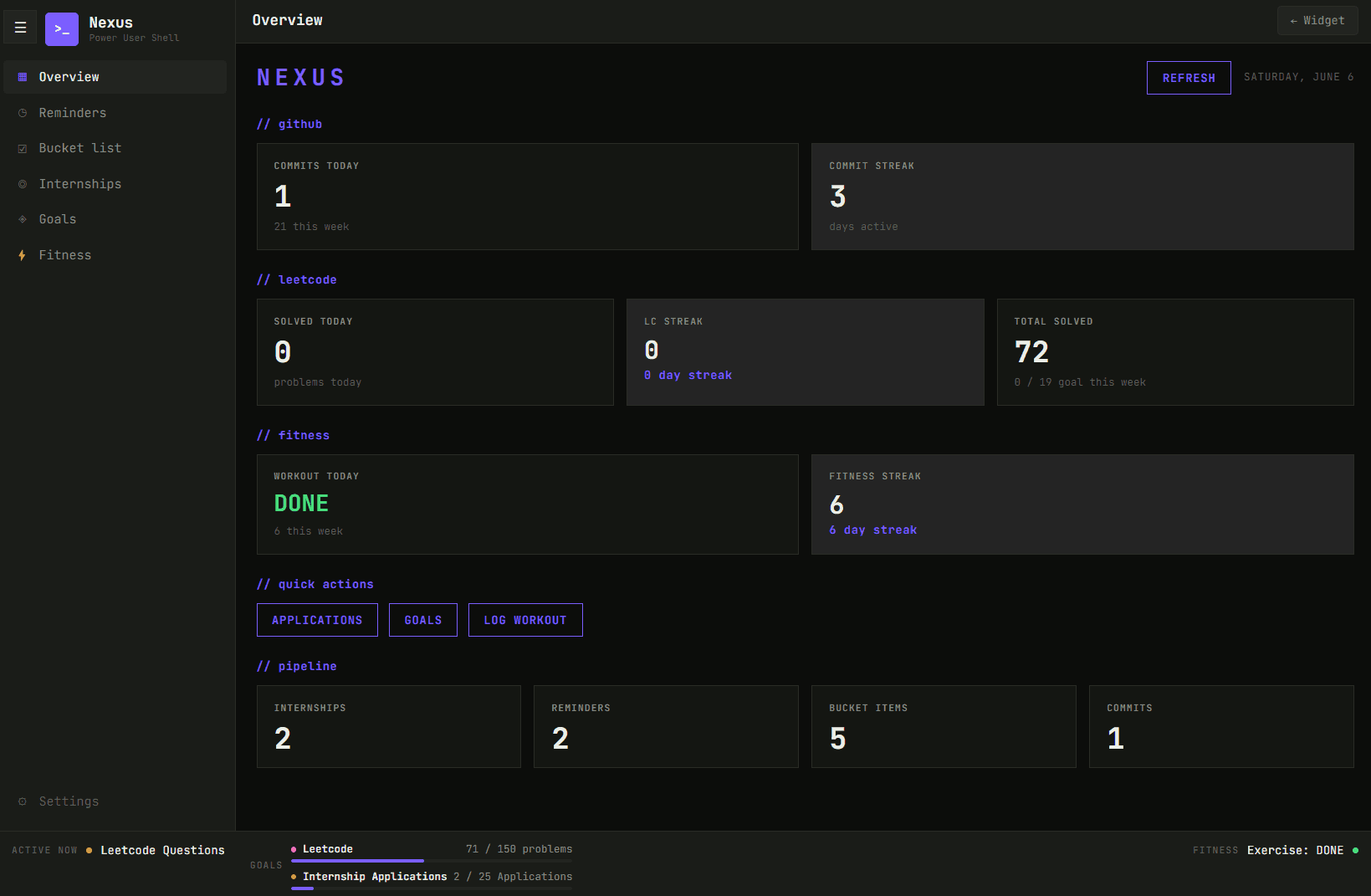
The expanded dashboard provides several areas for managing daily and longer-term activity:
- Reminders with priorities and OS notifications
- Bucket-list tasks
- Internship applications and follow-ups
- Goals with progress and weekly pace
- Fitness logging and streaks
- Developer activity from GitHub and LeetCode
The goal is not to replace dedicated applications for each of these areas, but to provide a single local view of what currently needs attention.
Local-first architecture
All application data is stored locally.
Tauri Desktop App
       │
       ├── Rust shell
       │
       ├── React frontend
       │
       └── Python sidecar
               │
               ├── FastAPI
               ├── SQLite
               └── MCP Providers
SQLite stores application data such as reminders, goals, internships, and todos.
The MCP providers handle external data sources independently, while the backend combines those results for the desktop application.
No hosted backend or application account is required.
What I learned
AceStar Nexus pushed me beyond building a web dashboard and into desktop application engineering.
The main things I learned were:
- Packaging Python applications as Tauri sidecars
- Integrating a Python backend with a Rust desktop shell
- Building modular MCP data providers
- Persisting local application data with SQLite and SQLModel
- Working with desktop notifications and window behavior
- Designing an always-visible interface without making it distracting
The biggest lesson was that useful information is not necessarily useful if the user has to remember to look for it.
That influenced the decision to make the widget persistent and intentionally limited in what it displays.
Current status
Active
AceStar Nexus currently includes:
- Always-on-top desktop widget
- React dashboard
- GitHub, LeetCode, and fitness integrations
- MCP-based data providers
- Local SQLite storage
- Reminders and OS notifications
- Internship and goal tracking
- Fitness tracking
- Tauri desktop packaging
The project continues to serve as my desktop-oriented evolution of the original Nexus architecture.